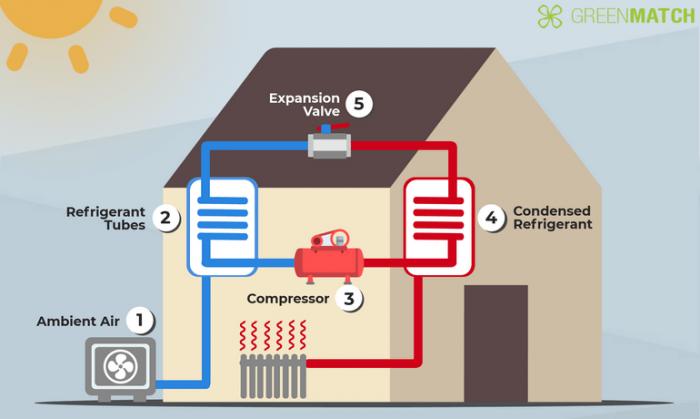
MIT Review has a nice explainer about heat pumps. I learned something. Of course, that's a low bar.

California's Energy Transition
MIT Review has a nice explainer about heat pumps. I learned something. Of course, that's a low bar.
With solar plants along vast stretches of the almost 2,000-mile U.S.-Mexico border on the Mexican side, a new high-voltage direct-current (HVDC) grid could be set up to transmit energy efficiently from that long, snaking array to population centers along the border. HVDC power lines lose exponentially less energy over long distances than traditional power lines. Cities that could immediately benefit include San Diego, Tijuana, Mexicali, Tucson, Phoenix, El Paso, Ciudad Juarez, San Antonio and Monterrey.As they point out, there's lots of strong sunlight along the border and cities on both sides of the border could benefit. Let's try it.
Yesterday, RWE confirmed a €5.7 billion loss in 2016 that it flagged a few weeks ago. Today, EON revealed a whopping €16 billion loss for the year, the largest in its history. Steep writedowns in the value of coal- and gas-fired power plants, along with the costs of cleaning up nuclear waste, were largely to blame for the shortfalls.Of course, in the story we find that these losses may be a sign that the German utilities are coming to grips with the transition.
Like RWE, EON recently split its renewables arm from its languishing fossil-fuel business.Link: Germany’s renewable energy push has forced $30 billion in losses on its biggest utilities
Under the EU 2020 strategy, the region aims to reach a share of 20 per cent energy from renewable sources in gross final consumption of energy.
On Tuesday 14 March, the European Commission announced that for 2015 the share of energy from renewable sources in gross final consumption of energy reached 16.7 per cent in the EU, almost double the 8.5 per cent recorded in 2004.
Given the hydro fleet's historically higher capacity factors compared with wind and the expected strong hydrological conditions on the West Coast this year, such as the recent heavy rainfall in California and the Pacific Northwest, hydro generation in 2017 will likely still be higher than wind generation even with anticipated continuing additions of new wind capacity throughout the year.Link: U.S. wind generating capacity surpasses hydro capacity at the end of 2016
In the biggest project since it acquired the solar cell giant SolarCity, the Tesla company will build a 13-megawatt solar farm on the island of Kauai, covering more than 44 acres (18 hectares). The solar cells will charge a 53-megawatt hour battery station able to provide most of the island's power at night.Link: Solar Energy Station to Power Hawaiian Island
Around midday on Friday, demand reached around 29 Gigawatts (GW), while solar was providing nearly 14 GW of generation — some 9 GW from utility-scale arrays and another 5 GW or so from rooftops and parking lot canopies around the state.Deaton rightly celebrates the achievement, but then goes on to cover some of the challenges California faces in creating a solar economy.
